Showing posts with label movie. Show all posts

20.1.12

Born into Brothels

Sonaguchi is a notorious red light area of Kolkata. Prostitution, abuse, drugs and many other evils had been thriving in the dark alleys of that slum. The most unfortunate ones of that slum are the innocent children on whom society have stamped the seal of outcasts. This is the story of eight children from this brothel, their lives, their fears, their likes, their dislikes and how through the efforts of two documentary photographers, for the first time, they starts to dream of a freedom from a curse that has been tagged on them from birth.

Zana Briski is a professional photographer and a social activist mainly working for towards empowering women and creating awareness of the condition and exploitation faced by women throughout the world. That is how she learns about the infamous red-light area of Kolkata. She travels to Kolkata to work with the local NGOs and take the photographs of the lives of people particularly women and children in these areas. But as a photographer it never worked out as she cannot go inside the slums and their homes to capture the very day to day life, most of them would shy away from an outsider who has come to photograph them.

During her stay she had to interact with many children of the prostitutes, from that interaction she thinks of teaching them some photography in return for the pictures that they take inside the slums. They  wouldn’t have any inhibitions to go to any dark corner of the slums, nor does the people bother some kids having time pass. Many drops out and finally the group closes to a bunch of eight children who were completely smitten over the art of photography. They would come to her house daily and there she would teach them the basics of photography, composition tips, post processing etc, then she would give them a camera and assignments to go into the brothels and come back with pictures. Soon she comes very close to these kids and there starts her mission to find out some way to save these kids from the brothels, particularly the girls whose destiny is otherwise the brothels of Sonaguchi. She and her friend Ross Kaufmann chronicle their experiences in Slums, the lives of the children, and their struggles to find a rehabilitation for these children as documentary.


The documentary is mainly in Bengali with English subtitles. The sight of the slum and the living condition of the people are sickening, yet the enthusiasm of the children over small small happiness could give heart aches. The first half of the documentary shows the lives of the children and their family. It follows the children as they run around taking snaps of the unawares, and showcasing some of the classic pieces of street photography captures by their eyes. They interviews the children, who talks about the kind of lewd questions the people ask them and their fear of falling into the profession the society have already thought for them.

Most of the families have been involved in pimping and prostitutions for generations and in such a tied up world apparently breaking away is a very difficult task. One of the girl Suchitra’s aunt had already received advance for transporting her to Mumbai. The boys don’t have that much fear as girls. One of the boy Gaur is determined to break out, as he says the future of the girls born there are in the worst waters. Now Zana and Ross have a task at their hands. Later part is mainly around how Zana and few friends try to rehabilitate these children through photo exhibitions and giving them recognitions in a wider society. Amnesty, UNICEF etc are few of the NGOs who have bought their pictures for calendars and awareness. They struggle in getting the parents convinced about the future of the children and few of them react positively, then she gets formalities sorted out of the labrynths of govt public service departments, speaks to various rehabilitation centers.
 

The documentary ends with the successful rehabilitation of few children and with a hope to continue this forward to other children.  One of the boys, Avijith, gets invited to attend the World press photography workshop in Amsterdam (only 9 children are chosen from across the globe!). They have opened an organisaton called Kids with Camera in Kolkata and couple of other places. The struggle for saving the children are still going on. This documentary can be viewed in various perspectives, from a child welfare, child empowerment, social isolations even street photography. A child is a raw gold, highly malleable, breakable, but pure, innocent. Our ears should hear every child’s cry, but they don’t!
 
This feature won the Academy award for the best documentary in 2004
More details:
http://en.wikipedia.org/wiki/Born_into_Brothels
http://kids-with-cameras.org/calcutta/

12.11.11

Kes

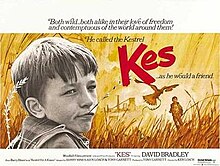
Kes(1969) is about the life of a boy named Billy set in a working class Yorkshire mining community. It is a hostile world for Billy, his day starts with abuse from his step-brother mostly violent, His divorced mother while trying to make the ends meet have no time to worry about her children. The apathetic school management’s attitude to the children from the working class makes the life even worse. With innocence lost, he is nothing better than a local urchin.

That is when he finds a Kestrel from a nearby farm, a bird known to soar high against the winds. He hides it in his barn and secretly trains the bird for falconry, he names it Kes. His fondness turns into a kind of respect to that bird. The bird’s destiny becomes the crux of Billy’s oppressed life.

Kestrel is quite symbolic here. As Billy explains about his bird to one of his teachers (the one who is more kind and understanding towards him),"This silent bird cannot be petted, but only be manned and yet it never becomes anyone’s slave. It does a favour by allowing its trainer come close to it because the trainer does a favour back by feeding it." Billy empathise himself with the bird, both share a similar hostile environment having to fight to keep up the dignity.

There are many other things that this movie passes by. The abusive nature of Billy brother reflects the frustrations of the work culture in mines. In a very conservative Yorkshire town the attitude of the school management reflects the class divide in the England of 60s. From the sadistic football coach to the bully at the school, the fragile social setup is quite visible subtly under their behaviour. One of the finest movies of Ken Loach which tries to dissect through the lives of working class of post World war England.
The movie is made based on the Novel A Kestral for a Knave by Barry Hines

17.9.11

The Hunger

On the wake of Anna Hazare’s Hunger strike, I happened to see a movie on another hunger striker, Bobby Sands. "Hunger", directed by Steve McQueen, depicts a real life story of IRA revolutionary Bobby Sands as he, along with other prison inmates, goes on indefinite hunger strike to protest against the English occupation of Northern Ireland and the denial to give political status to the IRA prisoners. The movie covers the days of “blanket and no wash” protest and the subsequent indefinite hunger strike. The hunger strike and subsequent death of 9 prisoners including Bobby Sands lead to a worldwide protest and condemnation of Margaret Thatcher’s policies and lead to a new wave of Irish nationalism.
 
The main theme of the movie is still Hunger, which is also metaphorically used as hunger for freedom. The movie explores the psychology behind the human will power to fight against the needs of his own body. With very little, and hard hitting, dialogues, the movie is slow and unnerving as it passes through the silent harrowing moments. As said, the monotony of solitary confinements doesn't spare the viewers as well. In the movie “Fight Club”, there is a dialogue which runs as “How do you know yourself if you have not got yourself into a fight”. In that movie, it shows the fight against one’s own body lead to a strange sense of liberation.  I believe same works out for hunger strikers, mainly because that becomes the ultimate weapon he/she can use to demonstrate their protests.  I somehow feel that such defiance increases the courage to continue, which is probably what encourages them to push their limits further. There are people who have attempted violent suicides, hoping for a painless quick death. Then there are people like this, deterministic on the slow death unwavering from their position despite being self aware of the state.
 

There is an interesting conversation between Bobby Sands and the Father Dominic Moran, who was called in to dissuade him from the strike. That scene, about 20 mins long, was shot in a single go, and comes up suddenly after an hour or so without any dialogues.   Michael Fassbender, who plays the role of Bobby Sands, went through a crash diet for the final part of the movie. The painful final minutes were indeed well enacted and picturised. The movie never tries to take sides. There is a scene where an IRA man comes and shoots a police man, in cold blood, inside an old age home when the policeman was talking to his aged mother, in front of her. It also tries to look at the conditions of policemen and wardens of the prison and how life becomes unsettling amidst riots and death threats.
 
After the success of various hunger strikes this has apparently become a favourite tool against establishments. Many bogus hunger strikers have emerged in political circle. Though many hunger strikes assumes the cloak of non-violence, there are always a threat of unprecedented violence on the event of the death of the striker. LTTE leader Thileepan, when IPKF was brought in, went ahead with a hunger strike. He thought India was still Gandhian and would consider his peaceful protests. But IPKF stayed and Thileepan died after 86 days. And we all know how they had started the plan to assassinate Rajiv Gandhi that moment and where it all ended. Similar thing happened since the death of Potti Sriramulu. That exactly would have happened, had GOI allowed Anna Hazare to fast until death. And that is what makes it a blackmailing act, which may or may not be an intention of the striker but definitely looms as a tipping point for an avalanche of human sentiments. That makes hunger strike a potentially violent act.
 
PS. Bobby Sands was elected to British parliament when he was doing hunger strike in the prison. Iranian government changed the name of ‘Winston Churchill Boulevard’ where British Embassy stood to Bobby Sands street. British embassy changed their entrance to adjacent street to avoid using Bobby Sand’s name in their address!

6.4.11

"Raavan" - Mani Ratnam's Maoist Ramayan

Mani Ratnam has been one of the film-makers who has keenly worked on portraying certain social realism in movies that are often very relevant to that period.. His movies are often woven on layers of different themes that are encountered by the plot as it thickens. For instance, Roja was made during the dark periods of Kashmiri insurgency where behind the love story lied the harsh realities of extremism and the emotions of the perpetrators as well as the victims, while in Bombay he explored the communal riot that broke loose following the Babari Masjid issue and the possibility of triumph of humanity over communal forces. Each of these movies had a firm layer on which he casted his story. In Raavan he uses the ongoing war between law and outlaws in the dense tribal zones of this country. He tackles the story from the point of view of three characters mainly. They each represent a party in the whole drama

Characters
Dev: The civilized, ambitious police officer assigned to maintain the law and order. Doesn't realises the crimes being committed by the officers from his group. Becomes the Law that apparently created lawlessness. He is the embodiment of the power that Law allows, his actions will be deemed as legal whatsoever be the means he take.
Raagini: Legally married to Dev, leads a happy married life. She believes Dev is police, legal and good while Beera to be outlaw, illegal and bad. She never realised the atrocities committed by the police. Her realisation of what is good and bad, what is legal and illegal, who is Raam and who is Raavan is a statement to us. She, very well, represents the 'People', who attaches itself to the legal side of the world. The one who is persistent in believing what outlaw does is wrong and what law does is right. She is ill-informed about the crimes committed by state. She is the one who has to take the fire test of loyalty at the end and decide who is right and who is wrong.
Beera/Veera/Raavan: The stylish, outlaw. His war is against the law. He is the saviour of the tribal, the master of guerilla warfare. He seeks revenge against the crimes committed against the innocents in the name of law and order. He represent all the forces resisting the law.

Ramaraavanan.
The main theme of the movie was the fights between the good and the bad. Dev and Beera are the two poles, their destiny is interlinked. They doesn't change, they are how they were and wouldn't escape their definite destiny. So what is the relevance of this theme? As the movie tag lines suggest, Is there a Ram in Raavan, is there a Raavan in Ram? Who will decide which of the two are what. Raagini forms the epicenter of the movie, the movie starts with a Raagini and ends with a different one. She transforms as she comes to know about the stories at the other end. The clouds depart, sky becomes clear. Finally she was able to decide. Going back the theory, People have many pre-concieved notions about the world. We read, discuss, apply logic but finally we do come up with some presumptions on various aspects. We trust the sources to be true, but are they always true? What if the things that you believed to be true was in fact a lie? Do we always get to see things from a bird's view? Was Ram really a good person?

Tribal world
The canvas on which the movies is drawn is a tribal world in the middle of a jungle. The hostile, humid, forest and its children who had been living closely for decades or centuries. The movie brings out the beauty to its fullest thanks to the directors of photography. It shows how isolated are these cultures from the rest of the country. There is an instance When Beera's brother bring food for Ragini which she declines with a sense of disgust, is  offended and he tells her that what she just refused is what they eat everyday. They are self-sufficient, they don't want big big things, they wouldn't even know what salary is let alone cribbing over it, they don't want pizza huts or shopping malls or multiplexes. World is not enough for whom, then? Tribal zones appears to have caught the attention for past couple of years. Tribal zones of Orissa, Chattishgargh, Jharkhand, Andhra, Karnataka are all targeted by big Industrialists. Attappady tribal zone has been in their radar following the geological survey reporting the possibility of gold reserves in the hills. Numerous tribal have already been evacuated for various projects. To them it is like expelling from their country. No one bothers doing some maths to assess the gain against the loss.

Ramayana
Ramayana is one of the popular epics of India, apart from that it is considered a holy epic. Ramayana is explained to the current world with a lot of disclaimers that is enforcing the reader to keep in mind that Rama is an avatar of Vishnu and Sita is the Avatar of Bhoomidevi,  to consider anything that is explained in the text to be gods will so as to prevent any logical questioning on the illogical things. Questioning the episodes like killing of Bali, Asking Sita for purity test, Humiliation of Shoorpanekha, Forcing Sita to exile, conducting Ashwamedham to expand the kingdom etc., though seemingly ungodly, could be considered blasphemy. Such epics have only one ending Gods win, Demons loose. It is very much the same in the reality.The fight between rights and wrongs will go on till the extinction of humanity, the question is how do you decide on which side you are. Beeras will die. Law always win the war. Everything comes back to normal, except Raagini. If at all there is any meaning to all the war that should be the one word - Change.

Hovering over the technicalities and faults
Raavan was one of the outstanding movies featuring subtle use of camera and technology. Camera and the background music blends with the ethos of the environment. The movie is a treat to the eyes of those who love the greenery, water bodies and the lingering dampness of evergreen forests. Talking about the shortcomings of the movie, the editing department had to look into the abrupt usage of scissors through the flow. Most of he scenes are short, due to which the director is not able to sustain the relevance of characters between scenes. If bad editing is indeed the case then they should realise it and bring out a director's cut version when they release the dvds. Lousy casting would be the next point, Mani Ratnam should realise that his signature on the movie is well understood amongst the movie lovers. He could have employed any new face in the movie and still people would come to watch the movie with the same enthusiasm
.All in all, there is something to ponder on the back of this movie. Not the lousy love story, but something more serious.