Showing posts with label essay. Show all posts

25.11.12

Shoulders of the Giants

What do I know about Robert Hook?. I surely have heard that surname before. It comes in one of those chapters that are kept for the last, called elasticity. Hooke's law. y = -kx where k is spring constant. This law was put forth after his experiments on spring, where he figured out that the pull of the spring is proportional to the displacement, obviously. The interesting thing is that it was used to put forth the idea of force for the first time that was before Newton put forth his laws of motion. That was not just one thing. Hooke was more of an experimenter and inventor. He had built several prototypes of microscopes, respirator, spring balances, clocks etc. One of the main funding for Royal society came through entertaining the elites using science. So they had to have a curator and Hooke was the most popular one.

Royal society in a way was Noah’s ark for science in Medieval Europe. Till Royal society had taken shape science was a hush hush word in selected, politically protected circle. It was a time when church was very powerful in Europe, particularly France, Italy, Germany etc where newer scientific fraternity was struggling to get a blanket or anonymity, often finding refuge under several secret societies. Several scientists were killed or silenced over heresy. Copernicus was burned at stake. Galileo Galilee was able to buy life in exchange for house arrest and it was when scientific renaissance was heading for a premature death, the protestant England was wholeheartedly looking to challenge the Roman Catholic rest of Europe by promoting anything that Catholics were against. Fortunately science was one of them. And a period of superstition, plague and civil war was paving its way to a new age of science.

Formation of Royal Society was not abrupt. It started with a group of philosophers and scientific enthusiasts meeting at Gresham College. Royal Society came to being in early 17th century with King Charles II giving the go and formulating the diploma for the Royal Society for study and promotion of science and philosophy . The new scientific revolution took Baconian scientific approach. Francis Bacon was one of the important non-scientists of the lot, but he realized and promoted scientific thinking through his philosophical lectures. His three stage process of starting with hypothesis first, followed by theoretical articulation and finally experimental confirmation, would still be pursued as the best scientific approach. Royal society has had several illustrious fellows, who would keep lighting up the scientific temper till the rise of modern scientific advancements.

The book by John Gribbin was a very enlightening read. It took me to the minds of some of the finest personalities in science. It also revealed a lot more about them and their personality. Some popular figures like Christopher Wren, an architect and a fine engineer who along with the other fellows of the society took up the task of rebuilding London after the great fire of 1660, Robert Boyle, an Irish chemist and physics got his assistant Robert Hooke to design him an air pump with which he demonstrated the Boyle’s law, Isaac Newton, Edmund Halley and their interactions and conflicts that would only build an incredible establishment for scientific fellowship. If there is a revolution, there would be rivalries. Perhaps they were the tipping points of several discoveries.

Rivalry between Newton and Hooke is the most popular of the Royal society ones. Newton was more of mathematician, while Hooke was more of experimenter. Hooke couldn’t become a fellow for a long for he was not a gentleman (whatever meant at that time), Newton was extremely introvert and doubtable schizophrenic. Their personalities had a common link, a sense of insecurity. It was not just around the concept of force did they lock horns. Hooke had predicted the planetary motion, made several thesis on optics, all which later got published in Newton’s papers without giving due credit. When Newton became the president of society he got all the portraits of Hooke dismantled from the hall. In popular science while Newton became a giant, Hooke diminished.

Perhaps we are not reading thing the way it should be. I feel we tend to idolize someone, and build myths and superman stories around them and betray an array of contemporary minds. What was Isaac Newton was he a physicist or a mathematician? What was Boyle, a chemist or physicist? Was Charles Darwin a geologist, biologist or a naturalist? Ernst Rutherford appears in Chemistry school textbooks, while he was a physics guy. Yet several of them, William Gilbert, William Harvey and several others. These are people who have never allowed themselves in any box. That is one fabulous thing about classical scientists. They are more of philosophers, guess that is why they are scientists too.

More interesting things: Originality of Species
.

3.7.12

War that couldn't end all the wars

In 1914, when the biggest and most horrible of wars that they have witnessed swept across Europe, H.G.Wells remarked that this will be the "War that will end all the wars", perhaps thinking that people would learn something from this war and work towards more peace. This was perhaps the last of the wars that were fought in many aspects. One, the use of military for imperial expansion started getting criticized. The wars to protect "humanity" started becoming more pronounced. The need for reasons to war became more necessary. Second world war had points to justify, it was fought to save humanity and the victims of holocaust still remind us about that.  But for the first world war, they didn't have any answer to those questions. First world war happened at a time when the world was turning itself around. The voiceless started getting voice, the people who were otherwise suppressed were getting empowered to let them be heard in the annals of history. In other words, the usual elites interpretation of wars and its cultural symbols started changing. People started asking why was this war being fought? Soldiers who otherwise never seem to have any significance in any literature or news started getting more importance. So such questions started moulding the nature of wars. League of nations were formed since the great war, which then became the United nations. But, most prominent of all the changes were the de-culturalisation of war. Pulling down all those glossy, heroic stories that inspired countries and kingdoms to war. In other words, the anti-war movements, which were in their nappies, started coming to age.

I was reading few books that incidentally sets itself around the First world war. The first one was a non-fiction called, 'Missing of the Somme'. This was the book that spoke of the aftermath of the Great war. The author travelled through the European cities exploring how the memorials are built and what message does the 'memorialisation' of the war, as projected to the later generations. It was since First world war the anti-war literature started becoming very popular. There were many war-poets and war-writers who wrote of the futility of wars and its brutal consequences and better options. Siegfried Sassoon, Robert Graves etc. are some well-known war poets, they wrote poems from trenches in Belgium, France borders.  The book heavily criticized the way the war is represented, which often being in the custody of warmongers, has only tried to justify their stance. A dead soldier is always a martyr for good cause. I remember a poem from school days where a soldier who was decorated for killing an enemy soldier consciously was awarded death sentence for killing another civilian in a drunken brawl. When you make someone martyr you are actually glorifying the purpose for which he died. A soldier who dies is always given a honour of one who tried to protect the people and safeguard the country thereby justifying the war, whatever be the original reason. 
The above mentioned book explored all the aspects of the Great war that is represented through paintings, sculpture, memorials, literature etc. It talked about sculptures that were commissioned by the governments, which gave a heroic representation of the soldier, then there are other sculptures that shows the other side of the war, of the faceless soldiers, soldiers crying over the body of his best mate, of soldier holding  his dead horse against his chest. The memorials were designed by many well-known architects e.g.. Luyten who had built New Delhi. One of the war memorial built in London is called 'Unknown soldier'. As a post war activity the governements had to ensure proper burial of all soldiers. But the war fronts were sprewn with countless un-identified bodies that it started getting difficult. So they picked whatever they could, the mortal remains of an unknown soldier, and was cremated in the capital city on which the memorial was commissioned. Siegfried Sassoon's and Robert Grave's poems spoke of bloody atmosphere of the war front where the supply is scant, so is ammunitions, poor communication devices, slow yet dedicated medical services and of strange state of humanity that people learn only after they experience hell in person. During the war, the punishment for deserters were death and thousands of youngsters were killed by their own nation because they flee from the war front, from a war that wouldn’t serve any better purpose. It was only recently the governments apologized to their families and gave them honours for volunteering for the war. Jean-Pierre Jeunet's A very long engagement tells the story of a girl trying to find her lover who was sentenced to death for trying to escape.
Another book was the last book of 'Regeneration' trilogy of Pat Barker. That was when the war was described with a bitterness, with a nonchalance that may sound suicidal. It was about a young soldier who was brought from the war front with shell shock, who after his treatment, has to report back at the front. The other character is the doctor of the hospital who has to witness countless causalities and broken down soldiers and try to recuperate them. Another book from the same writer was 'Life Class'. A tale of two youngsters and how a massive force like war impact the idea of love, art and freedom.  It retells the horror of the war through the eyes of one of the protagonist who volunteers as nurse in war front.  Both the novels emphasized on the brutality of the war and its vanity as opposed to the excitement and chivalry that normal war literature give. It was a pointless war, where  people went and died in scores. There wasn't a definite answer to the question as to why was that war fought? Was that the vestiges of imperial strength show that it had to prolong unnecessarily.  In  the narratives, we could feel the hopelessness of a soldier who might very well be walking into his death. That book had received Booker prize in 1995
'Penguin book of First world war stories' was the last one. It was a meticulously arranged collection of short stories told in the backdrop of First world war. It had stories written by Somerset Maugham, Joseph Conrad, Katherine Mansfield, Conan Doyle, Julian Barnes etc. It is arranged into 4 sections  - Stories from the front of which a story called 'Blind' by Mary Borden and A. W. Well's 'Chanson Triste' were incredible, second one was on spies and intelligence used during the first world war - Sherlock Holmes appear in one of them penned by Conan Doyle, At home - this section had stories of people back home, of mothers  waiting for their sons, Hugh Walpole's 'Nobody' was a heart breaking tale of a 16 yr old boy who faked his age to enter the army and was sentenced to death for deserting, and In Retrospect, it was about the impact of war in the future generation. Julian Barnes' 'Evermore' was the best amongst that. The story was an attempt to exorcise the ghosts of un-redeemed soldiers and their stories that got buried under the bigger second world war that eclipsed the first. Christian Caron's movie Joyeux Noel is based on a story from this book, the incident was real though, where on the Christmas days the soldiers from British, French and German fronts defied the higher commands and celebrated the festival together.
In the movie 'Troy' Odysseus tells Achilles "This war will never be forgotten, nor will the heroes who fought in it", but do anyone remember anyone other than Achilles or Odysseus or Hector? , in Baghavad Gita the war was a righteous move to get back what was rightfully theirs, to protect dharma (whatever that means). Is it a dharma of a poor foot soldier to die unnecessary for a feudal war between two arrogant clans of co-brothers over who will own the kingdom? Had those soldiers been given a voice they would have called Mahabharata an epic blunder. If you look at the gods and heroes and legends that people follow or worship there is this war or their violent nature associated with it. There is an embedded heroism in war that still hasn't lost its seductive charm. It shows off patriotism, manliness, heroism etc.  People hate Gandhi for his unmanly non-violence philosophy. And on the contrary adore authoritarians inspired over their megalomaniac tendencies. 

Around 1000+ American soldier died in the last Iraq war, and they were honoured for protecting humanity. That is just like legitimizing the war which was fought for oil companies as something fought for humanity, waged to safeguard the world against mass murdering despotic country. And every dead American was made a martyr, like he died trying to protect his country or even the world. A 100 years ago a country never had to give an excuse to fight wars, but now they have to. So it is the duty of the governments to demonise a country before attacking it. If you read the amount of propaganda materials against Iran, however true or false, one cannot escape a thought on the need of such necessity. In the naxal hinterlands, the brutality of naxalities are measured in terms of number of CRPF jawans or policemen killed. Higher the number more brutal they become. Though they are deployed there to protect the interests of some mining company, their martyrdom makes an impression that they are there to fighting for people. The people back here loves it. To many war is the first step of negotiations. "The rush of battle is a potent and often lethal addiction, for war is a drug" said Chris Hedges in "War is a force that gives us meaning" .  For that reason there is an overt inclination to such violence of huge proportions. The thrill of some poor soldier killing another can always be an incredibly good entertainment for the public, like getting a chance to view their frustrations getting redeemed.  In all the wars perpetrated in democratic nations, the culpability of the public can never be underplayed.  H.G.Wells may have been wrong,  what couldn’t end all the wars started the fire at least.

17.9.11

The Hunger

On the wake of Anna Hazare’s Hunger strike, I happened to see a movie on another hunger striker, Bobby Sands. "Hunger", directed by Steve McQueen, depicts a real life story of IRA revolutionary Bobby Sands as he, along with other prison inmates, goes on indefinite hunger strike to protest against the English occupation of Northern Ireland and the denial to give political status to the IRA prisoners. The movie covers the days of “blanket and no wash” protest and the subsequent indefinite hunger strike. The hunger strike and subsequent death of 9 prisoners including Bobby Sands lead to a worldwide protest and condemnation of Margaret Thatcher’s policies and lead to a new wave of Irish nationalism.
 
The main theme of the movie is still Hunger, which is also metaphorically used as hunger for freedom. The movie explores the psychology behind the human will power to fight against the needs of his own body. With very little, and hard hitting, dialogues, the movie is slow and unnerving as it passes through the silent harrowing moments. As said, the monotony of solitary confinements doesn't spare the viewers as well. In the movie “Fight Club”, there is a dialogue which runs as “How do you know yourself if you have not got yourself into a fight”. In that movie, it shows the fight against one’s own body lead to a strange sense of liberation.  I believe same works out for hunger strikers, mainly because that becomes the ultimate weapon he/she can use to demonstrate their protests.  I somehow feel that such defiance increases the courage to continue, which is probably what encourages them to push their limits further. There are people who have attempted violent suicides, hoping for a painless quick death. Then there are people like this, deterministic on the slow death unwavering from their position despite being self aware of the state.
 

There is an interesting conversation between Bobby Sands and the Father Dominic Moran, who was called in to dissuade him from the strike. That scene, about 20 mins long, was shot in a single go, and comes up suddenly after an hour or so without any dialogues.   Michael Fassbender, who plays the role of Bobby Sands, went through a crash diet for the final part of the movie. The painful final minutes were indeed well enacted and picturised. The movie never tries to take sides. There is a scene where an IRA man comes and shoots a police man, in cold blood, inside an old age home when the policeman was talking to his aged mother, in front of her. It also tries to look at the conditions of policemen and wardens of the prison and how life becomes unsettling amidst riots and death threats.
 
After the success of various hunger strikes this has apparently become a favourite tool against establishments. Many bogus hunger strikers have emerged in political circle. Though many hunger strikes assumes the cloak of non-violence, there are always a threat of unprecedented violence on the event of the death of the striker. LTTE leader Thileepan, when IPKF was brought in, went ahead with a hunger strike. He thought India was still Gandhian and would consider his peaceful protests. But IPKF stayed and Thileepan died after 86 days. And we all know how they had started the plan to assassinate Rajiv Gandhi that moment and where it all ended. Similar thing happened since the death of Potti Sriramulu. That exactly would have happened, had GOI allowed Anna Hazare to fast until death. And that is what makes it a blackmailing act, which may or may not be an intention of the striker but definitely looms as a tipping point for an avalanche of human sentiments. That makes hunger strike a potentially violent act.
 
PS. Bobby Sands was elected to British parliament when he was doing hunger strike in the prison. Iranian government changed the name of ‘Winston Churchill Boulevard’ where British Embassy stood to Bobby Sands street. British embassy changed their entrance to adjacent street to avoid using Bobby Sand’s name in their address!

1.9.11

What is it with corruption

What is it with the protests against corruption that attracts much people, that protests on other crimes do not? Irom Sharmila had been fasting unto death for repealing the Arms force special act from Manipur. Medha Patkar had been doing various protests for long, for Narmada bachao andolan, recently against the eviction of a slum for some new building. But none of the above stuffs managed to gather any significant public support as the fight against corruption did – considering the fact that the corruption in various forms has become a part of daily life of individuals! Every employed/unemployed lower/middle/upper class would definitely have had their brush with some or the other forms of corruption. Giving bribe to get something done quickly, or maybe a traffic policeman or quoting wrong figure in the land/building registration paper. Still why are people against corruption?
Ranking


Money is a big factor for all the classes, especially the middle class for whom tax is nothing less of an enemy. Nobody wholeheartedly love paying tax. It would be surprising to find people giving away tax with pleasure and a smile just because this money funds some state school or subsidize the vegetables. And there wouldn’t be anyone who have tried all sorts of schemes and techniques to save the tax. Now, despite of all the efforts we sometimes have to pay some money every month as tax. It is this piece of heart that is flowing into the pockets of certain set of people (that probably deserves only despise), explaining why corruption is such a painful thing for middle class. This explains why a dam, invading the home of a lakh farmers, or Arms force special act, curbing someone’s rights, is not much of a concern to the wider public. This also explains why the public is adamant over political corruption which according to me covers only a small percentage of the total corruption. The amount of corporate tax evasion using existing loopholes, buying out the officials or making policies convenient to them, is a much bigger territory.


I was reading an article about the tax havens, tax evasion and corporate and government’s role in it. First of all, these Tax havens and other lucrative techniques were not built by politicians nor are they built for them. They probably do hold sufficient money in many lucrative banks but that just comes to a very insignificant(for the country?, oh no!) percentage. Most of the major transactions pass through tax havens, the report says. On top of that the misquoting of taxable and non-taxable items helps evade tax better. Every year approximately 5 lakh crore rupees of corporate tax are being written off in this country and to me that is nothing short of 5 lakh crore worth a scam! The black money, tax evasion etc are some the business as usual for corporate and hence day dreaming that routing out corrupt politicians would end corruption is just futile because they are just middle men in this whole drama.


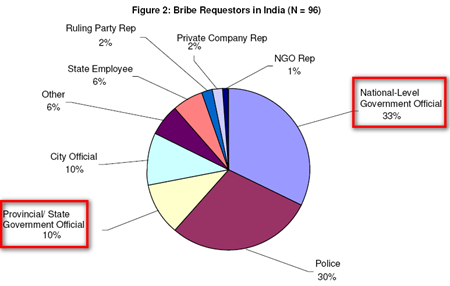
Bribe requestors in India
Today’s newspaper showed how RIL had been goofing the treasury department by quoting over hyped rate over the Krishna Godavari natural gas extraction and supply. The claims, that the license-raj devil can be wiped out by liberalization, proves to be just a lame tirade of the investors lobby. On the contrary what we are witnessing is pure puppetry. Just like how various corporate lobbys, pulling the strings of US policies, have shown how dependent corporates are on policy and law makers, every corporate house expects a corrupt government to be in place so that their monopolist intentions be well managed. We witnessed several high adrenalin protests against the politicians on 2G scam. The investigation reports did mention their names so they rightly deserves chappals and eggs, but the reports also mentioned the names of Reliance, Tata, Uninor and many well known corporate houses. Forget about high decibel cries, did we hear any word being spoken about these big shots in media or any other social gatherings or sites or forums? It could be imagined that Raja wouldn’t have sent out an email to all these chaps asking whether they want some spectrum. In the corporate world politicians are merely agents who gets things done for them, just like a middleman. If these middle men deserves stones and sticks, their employers deserves much more.


Imagine, if Anna Hazare asks the protesters to sell all the Reliance or Tata shares that they are holding, to protest against their corruption, how many of the corruption fighters would be ready for that? What are the chances that Anna Hazare gets tagged as a joker or something like that? Some might want to argue that, as they bring ‘development’ and all that nonsense, it is ok. So should this be interpreted as – I am ok for corruption as long as I am getting a cut out of it? My question is, whom should I slap first? :).


7.6.11

George Orwell & Animal Farm

In my opinion, nothing has contributed so much to the corruption of the original idea of socialism as the belief that Russia is a socialist country and that every act of its rulers must be excused, if not imitated. And so for the last ten years, I have been convinced that the destruction of the Soviet myth was essential if we wanted a revival of the socialist movement.

- Preface to the Ukrainian edition of Animal Farm, as published in The Collected Essays, Journalism, and Letters of George Orwell : As I please, 1943-1945 (1968)


It was only recently that I picked up the Animal Farm from the library, for reading. I had read two of his auto-biographical works ‘Homage to Catalonia’ and ‘Down and out in Paris and London’ and had ever been glued onto the Orwellian perspectives. Animal Farm is, as anybody would know, one of his most popular satire based on the Soviet union during the Stalin’s rule. As much the story is, interesting were the introduction and several prefaces that had been compiled over the book. And as the literary critics claim, this had been one of the daring satire on Soviet Union and highly misinterpreted book much to the sake of the cold war propaganda machines, which in fact contributed to its immense popularity.


George Orwell, born in Calcutta, left for England for schooling to come back later to Burma to join the Indian Imperial police. Having witnessed the ruthlessness of imperial police force he quits the job and leaves for England to concentrate on literary activities. Like many writers and poets did in those days, to free themselves from bourgeoisie culture, he decided to lead a ‘Bohemian’ lifestyle in a Parisian working class suburb in a tiny uncleaned room infested with bed bugs. He later spends a similar life style with the tramps of London. His Down and out in Paris and London comes from those adventures.  He later travels to Catalonia to fight along with Anarchists (Trotskyites), against Franco’s fascist forces during which he gets shot through his throat. His Homage to Catalonia accounts his adventures on the war front, commentary on the sophistications of a subaltern’s army and the betrayal of the Soviet supported allied troupe. In between the war, the idea of permanent revolution and the war of independence locked the horns of the Trotskyites and the Stalinists. Orwell believed in a socialism that promoted human freedom and a classless society which he found in Barcelona when it was under the control of the anarchists. Waiters never accepted tips, none address each others as senors or senoritas – they were all comrades. But then the Stalinists, who had been supported by the soviet union, wanted to postpone the revolution for the sake of war against the Franco, which they argued couldn’t go hand in hand as Trotskyites claimed. This later took an ugly turn when the Stalinists captured the Anarchists buildings leading to an internal crisis and bloodshed which ended in the persecution of the Trotskyites as traitors. The Stalinists were much ably equipped with arms compared to the Trotskyites, latter only armed with rifles that either explode when fired or are always jammed. Orwell though manages to escape the persecution, had to witness all his comrades getting captured and ‘disappear’. 


Europe, at that time was heavily influenced by the success of Russian revolution. It was, since the failure of Paris Commune, the proletariat government coming to existence breaking the cynicism of the right-wing world. The intellectuals, workers, peasants were all in the move to change the face of Europe. Labour parties and new leftist movements erupted throughout the world since then. Orwell after compilation of the Homage to Catalonia found it difficult to get the book published, which was then picked up by a pro-Trotskyites publishing company which gave much negative publicity to the book as it was conveniently made to believe a Trotskyite propaganda behind it. The idea of Animal Farm must have been in his mind ever since that incident. Orwell was surprised at the silence Britain was having against incorrect propagandas of the Soviet Union and on its contrary censorship move against any anti-soviet union literature. It was a situation where a criticism against Britain is tolerated while a criticism against Soviet union was not. He was annoyed that when the British press did wrote in detail about the famine in Bengal, they chose not to report the famine in Ukraine.  The Soviet Union, at the meantime, was improving ties with European nations through the workers union and intellectual circles which were having tremendous influence in the political arena as it would prove in later years at the emergence of socialist parties in Europe. Hence, after he compiled the Animal Farm there was no publisher ready to pick the work out of a fear of displeasure from the government. He quotes, the left leaning publishers were blind and wished to stay so while the right-wing publishers shied away quoting excuses like unavailability of paper and representing the head of the Animal Farm a pig. The only publishing company that came forward was the same Trotskyite leaning Secker and Warburg who published his Homage to Catalonia. Both the author and publisher was aware that this work might get criticized as a usual Trotskyite, anti-Stalinist literature hence that book was, after several delays, published post war as Animal Farm: A fairy tale.


This was, thus, initially promoted as a children’s book, much to Orwell’s annoyance. And since the end of World war and the beginning of the cold war, this book rose to immense popularity due to its childlike narration of history of modern Russia. As mentioned earlier, much to the irony of the original theme, this was then set to become part of the propaganda machines of capitalist block during the cold war, primarily United states. The prefaces of the American editions were largely botched, trying to convey that Orwell was actually writing against Socialism. Much of Ronald Reagan’s propaganda videos tried to replicate the imagery created by Orwell’s Animal Farm. An abridged version was later included as part of the children’s curriculum in schools as a lesson on the evils of socialism. It became a household name for utopian socialist society. Naturally the book was banned in all the soviet bloc’s as well as the countries on soviet alliance adding value to the myth. Though the original title had ‘A fairy tale’ written on it, that was taken out by many publishing companies later so that people don’t ignore it as a children’s book. Several right winged book reviews generously praised Orwell for his anti-communist intellect. Some even argued that this book received much acclaim purely due to its utility during the cold war time.

 
Much to the polarized state of the world during cold war period, a critical study of his work was not widely taken up due to its political influence. Interestingly it was children who alone took the book in its right sense. When spoke to some children, what they understood from the story was simply right, what Orwell wanted to say. The children spoke that they supported the animal farm when they overthrew the Mr. Jones as Mr. Jones was abusive and treated animals badly, while later, was saddened by how evil animals like the Pigs cheated and killed good animals like the horses, for power. There were many critics who question the usage of Animals taking control of the farm from Humans, as it portrays an unrealistic takeover. This picture was again used to convey a futility of a socialist system that it is inherently unstable. The true failure had nothing to do with the animals taking over the farm. In fact the story did proceed with the initial success of their farm through equality and hard work. Orwell states in his prefaces that his intention was not to project the takeover of farm by animals as a futile move but rather pin point the corruptibility  of power, that lead to the ultimate betrayal of the revolution. Looking at his writings and his accounts on days with anarchists, he probably favoured a liberal socialism with an inclination towards anarchism, out of his distrust on any ‘ruling’ system or ‘big brother’ susceptible to corruption (expressed in 1984).

29.5.11

Behind the Breaking news.

The prominence of media in the pseudo-democratic society like India is not under-rated, with most number of newspapers and news channels in several languages frantic on a pursuit to let the people know of the latest hot news. Media, being the fourth estate of a nation, has played its part for keeping up that little bit of democracy it could. At the same time it is challenged by the upper hand of the politics waging secret war against the true journalism. One of the great things that happened in the recent years must be the Rights to Information act rolled out by UPA I. Though now they are realizing the sting of its bite, and is working towards restricting its range, it brought the public closer to the wynds of journalism. Interestingly Journalism is getting crony, while the new age whistle blowers and RTE activists try to fill that gap, often leading into their persecution and even assassination, as we witnessed in last few years. 

I happened to read a fabulous book called 'Breaking the big story: Great moments in Indian Journalism' where nine journalists accounts their moments of adventure, fear, joy and despair while bringing some of the news that shook the pillars of this country. Many of them have been forgotten by the public even when the aftershocks of the buried lies continue to the rock the belligerents’ bases even today. Ever after the advent of 24x7 channels, the public have been mislead to believe that Prannoy Roy, Barkha dutt, Rajdeep Sardesai  and many other figures scurrying over the already reported news with their verbal circus constitute the fraternity of Journalists. And the public seldom delve beyond those smokescreens to get to know the actual reporters and the effort and pain they have put to bring the scams, scandals, truths and lies through grass root level reporting. This book doesn't simply stagnate at the stories as such, but also reveals the adventurous and dangerous culture of journalism.

The book is edited by the eminent media analyst and statesman B.G.Verghese. He gives the introduction to the book passing through the prominance of media in the democratic society like India and how the democracy itself got strengthened and at the same time challenged by the secret war between the true journalism and politics. As he emphasised the need to report a news from all the sides as opposed to the one-sided reporting which he believes is caused by the 24 hour news broadcast trend that is depriving the journalists the liberty to report the right news. While he pointed out the relevence of Rights to Information act passed by the UPA govt as landmark in terms of making the system transparent for the public and at the same time, ironically though, he was emphasizing on certain restrictions in RTE. He treats it diplomatically by appreciating the impact of RTE and at the same time mildly raising the apprehensions of information leak. I couldn't agree with that part though, as any legislation brought towards restrictions in RTE would end up eating the whole thing up, unless judiciary intervenes, which will be an unnecessarily laborious task in India.

The stories covered are - Bhopal MIC tragedy by Raajkumar Keswani, The starvation deaths of Kashipur by Sampad Mahapatra, the Nelli massacre by Sanjoy Hazarika, Tamil genocide in SL by Anita Pratap, the post militant political Kashmir by Muzamil Jaleel, match-fixing scandal in Cricket by Pradeep Magazine, Bofors scandal by Chitra Subramaniam, Tehelka sting operation by Tarun Tejpal and finally on the Gujarat communal violence by Teesta Setalvad. The authors of each chapters tells it from the beginning of their involvement, how they got the tip, ravelled each piece of jigsaw, brought the story into public, were accepted by public, hunted and harassed down by the wielders of power and their lives impacted by these work.

Book starts with the account of Raajkumar keswani, a small time reporter from Bhopal who had been reporting about the potential danger of the union carbide plant in the village ever since it was installed. Even before the final disaster, he accounts, there had been small leakages and minor industrial disasters that had claimed the lives of many workers. Despite of the safety and standards audit showing dismal performance by the company, the government never bothered to investigate the news reports he published. Until the disaster struck, none of the news papers, except Indian express in a single occasion, bothered to throw some light on it. I wonder how many such news reports are getting overlooked or purposefully downplayed in this country, waiting for the tragedy to happen. Jaitapur Nuclear plant, Mullaperiyar dam, how many more? The massacre at Nelli was no different. The illegal immigration from Bangladesh, and gross social unrest that were perpetually downplayed by the government and equally ignored by national media ultimately culminated in a gruesome massacre of Bangladeshi immigrants in Nelli village in Assam.

Chitra Subramaniam's and Anita Pratap's accounts had many similarities; they are the 2 women who brought much trouble to Rajiv Gandhi. One in the form of Bofors scandal whiles the other on the Tamil massacre and about subsequent involvements of IPKF into this trouble.  She being one of the few journalists who had been into the war front news correspondence early in the times of print and radio journalism, tells about her rub-off with the defence and intelligence officials despite whose hurdles she was able to bring eye-witness accounts of civil war in Srilanka, which in fact boosted the morale of the Army. When the passion of journalism creeps into the blood it eclipses everything, even the family, says Chitra subramanian. But as all the fights against a powerful system are destined, both of them had to finally quit although she pursued it even after The Hindu took the story off its shelf following political pressure. And after the assassination of Rajiv Gandhi, to their dismay, the investigation went into total oblivion.

In a civil society which is not transparent yet, I personally believe that, the people in power should never be given any benefit of doubt. Looking the balance of power, there is hardly any place in this country where we can say that, here people are in power and not politicians. In such a place, a good journalist would be the one who is a thorn in the velvet cushion of the powerful. The big news is big only because it shakes the establishments of power. Such a government having sold itself off to the private parties tries to play off a mean game against a village that is reluctant to give way to a mine in Orissa. When several villagers in Kashipur died, the village officials decided to write it off as food poisoning, which was in fact a food poisoning induced by un-availability of food. Sampad Mahapatra got involved in the investigations that told a simple fact that, in the time of dire situations humans try to find something to hang on. And these villagers, having been denied their rightful share of ration, had been pushed to a state where they had to consume contaminated dried mango kernels and wild mushroom. The government still stands by their claim that it was a mere food poisoning, and consuming mango kernels was their tradition.

The thin line between an investigator and reporter, between activist and reporter is tested in many such cases. I cannot deny that even when I am typing this, there is someone scheming about some crime of wide social consequences. Plenty of things happening around, often under our noses or about something which is outright guessable, like the illegal mining, encroachments, land mafias, defence lobbying. A true investigative reporter should be able smell those trouble, says Chitra, which was what she had been looking out in the multimillion deal that was being signed between the Swedish arms giant Bofors and GOI. It is the same sixth senses that lead Tarun Tejpal to initiate his Operation west-end that trapped money hungry politicians and army officers in sting operation. Pradeep Magazine's scoop came out through a casual talk with a bookie in West Indies which prompted him to disguise himself as someone close to the cricketers. His adventure ended up in exposing one of the biggest match fixing scandals that rocked the trust of millions on the game of cricket.

Jaleel's account on Kashmir talks about how, as a journalist, his credibility was tested in Kashmir as caught between devil and deep sea. If a journalist writes about atrocities of Kashmiri militancy he would be declared as pro-GOI and would end up becoming a target for separatists, whereas if he writes about army atrocities the GOI would declare him as pro-separatist and could end up in censoring his articles. Being a territory of where a sane journalist would never want to stay, he managed to survive and had been successful in gaining access to the areas which had been barred for other journalists. He accounts for how many journalists have been targeted in Kashmir, as he says Army takes it away in day time and militants takes it away at night. He isn't sure how long he can survive in a place of least press freedom and high volatility without losing the trust of either side.

Beyond the stories, it also tells how these impacted them personally. Anita pratap talks about how RAW agents were advised to threaten her by kidnapping her son, if she did not reveal the names of her sources of leaked news.  Chitra Subramaniam speaks of how terrified her husband and in-laws was when she was making calls to the sting agents in sweden, on Bofors issue, two days after the delivery of her first child, from the hospital bed! And Tarun Tejpal recounts the tense moments of Samuel Mathews and Anirudh Bahl and their laborious editing phase and the period of dark clouds when Tehelka was destroyed from the arena. Teesta Setlevad's account on post-godhra riot had the flavour of human rights activism more than journalism. Her’s were the account of how a state deliberately tried all it could to let the rioters have a carnage for days. The reluctant hospitals, who denied treatment to wounded, unbothered police force and the ordeals in bringing the guilty in front of justice, are accounted in the final chapters.  

Often the journalism has come under the scanner of being biased, this stigma still holds true in all the major media houses. They often end up as mere mouthpieces of either the political parties or corporate. Hence the biggest challenge a journalist face would be to get the facts sorted out from all the parties. Taking the case of the Maoists insurgency or the Kashmir issue, only a few media did cover the news from all perspectives. The new age of 24x7 news channels has failed in this case, mainly because of the competition to report something before the rival channel. They invariably end up with the most easily accessible sources, like the police or army or political spokespersons for news, editors then sensationalize it and that comes as breaking news they are not patient enough to get the complete picture leading to bias in the report, which they hide skilfully with their diplomatic statements. Another problem with the 24x7 channels is that the shelf-life of a news item is very less. News of importance loses its temper after few days or until another breaking news surfaces. Ultimately this TRP hunter ends up more as a bane rather than becoming a boon! So, while the TRP hunters are on their spree, all we can do is to trust those unknown faces that are on prowl at the backyards of the society to unveil the veiled.

12.3.11

Classical science, convergence and some thoughts

Few months back there were some discussion about science and superstitions in bulletin board. Needless to say, much of the arguments ‘for’ superstitions were in fact attacking the idea of science. Few questioned the superstitions in the science too, which I thought was valid(strangely, though it was not the intention of the questioner to point out the beauty of science) - do you believe in Einstein’s special relativity theory? Do you believe in Schrodinger’s experiments? Do you..?. Science has nothing to do with believing something. Science is that which is enquired upon, it is the liberty to do experiment and question the properties and nature of the natural world. People who believe in some scientific theory, because it is an accepted theory, are nowhere different from a person believing in ghost. Having that innate itching to question things is the real scientific temper because scientific theories could be wrong. Long ago Anaximander proposed an idea of geocentric model of universe. His philosophy, simple and backed by many accurate observational points, was that the earth is at the center of universe which revolve around it. Similarly Rutherford’s model of atom was a well known hypothesis. Though their theories have now been proven wrong, it doesn’t take away the scientific methodology adopted by either. We know, Later the church adopted and somewhat ‘base lined’ the geocentric theory. They attacked the scientists who put forward the heliocentric theory, and were marked and killed as heretics. The interesting part of this argument is pointing to how the same theory were defined as scientific and superstitious based on how the lines are drawn around it.

I believe classical science played a major role in drawing the lines between the hypothesis and proven facts, it didn’t give space for approximation or caveats and was persistent in defining the natural world with classical mathematics. But there were always something that baffled the scientists and mathematicians which finally brought forward the idea of Convergence. For instance, we know 1/3 + 2/3 is 1, but 1/3 is .333.. and 2/3 is .6666.. and when you add that up it just comes to .99999…. which a classical mathematician equated to 1 with a glass of water. Philosophical thinkers which dominated the scientific fraternity didn’t have anything other than the convergence theory to agree upon that .9999… converges to 1.

There was a famous paradox, which is often used to explain the convergence theory in a classical physics experiment. It was the same old story of the Hare and Tortoise, quite popular hence very likely that you have heard of it. In this story, Hare was confident that he will not sleep on the way and Tortoise, as usual, appeared cool and unperturbed. He approaches the Hare with a humble request, “Mr. Hare, Since you are very quick why don’t you give me a little advantage of starting 10 meters ahead of you, 10 meter is all what I am asking from you”. Hare laughed out loud thinking of Tortoise’s inanity and agreed to the condition. Now the Tortoise will start from a point 10 m ahead of Hare’s starting point. Monkey blows the whistle and the race starts. Now let us apply classical theories into their race..

The hare running at V velocity takes T1 time to cover the first 10 meters, ie after T1 seconds Hare reached the point where Tortoise started. But, Tortoise was not simply standing there, he was walking with a velocity of U and has, by now, covered a distance of U*T1 meters and is still ahead of the Hare. Now Hare takes another T2 seconds to cover the distance U*T1 meters and reaches the point where the Tortoise was, at the end of T1 seconds. But the bugger Tortoise is again U*T2 meters(however small) ahead of Tortoise. Going by this, Tortoise will always be U*Tx meters ahead of hare..which means as per the above explanation the hare would never overtake tortoise!! (Or will this race ever end?). But in reality we know the race would end, and hare would overtake the tortoise. The only explanation to this could be given by the convergence theory, i.e. as the distance between the hare and tortoise becomes infinitesimally small after infinitesimally small fragments of Tx, it is safe to assume that the distance between the hare and tortoise is 0! I.e. as limit Tx->0, the U*Tx->0 and hence after sometime Hare and tortoise would end up in same line. That was the only way this race could be explained with mathematics. To many, it was a failure of classical mathematics in clearly explaining the natural physics, which was otherwise considered as the ‘unambiguous language’ of physical nature. The idea that, a measurable quantity like 1 sec or 1 cm could be divided into infinite quantity of infinitesimally small units even gave the prominence of infinity in mathematics and natural science a stronger base.

Classical science relied on the observation and observational experimentation which involved macro subjects that are quite readily available, visible to human eyes and comprehensible to the human brain. Chemistry was probably something that split the philosophers as the experiments often convoluted into magic, but the idea of science and philosophy were, very much, hand in hand until the end of macro science and evolution of micro science. Now the uncertainty and approximation has changed the way things are seen. It has gone beyond the limits of human imagination, looking at the way the scientific reasoning during the age of enlightenment lead to evolution of the classical science, as we get into the age of nano science. Things are changing, The modern physics may not be able to appreciate philosophers. With the evolution of nanotechnology, philosophy of physical science had been getting heavily dependent on ultra-precision equipments and confined to the walls of expensive laboratories. Astronomy is probably the only classical realm that still remains undiscovered to a large extend. This well known arm of philosopher’s physics still manages to elude the boundaries of human imaginations.

9.3.11

Future of food

Had been watching a BBC feature called Future of food, basically much about the future of food production and consumption and the trend seen across the world and how much the third world countries have been “feeding” the developed countries.

Hungry kya?
Few interesting facts presented in that documentary were, like 70% of the food items imported by Britain comes from the countries where there has been a history of famine, starvation deaths and food riots, this includes countries like India, Pakistan, African countries and South American countries. In one of the episodes the narrator travels to India speaking with various farmers about the problems they face, the responses were like the water shortage, excessive dependency on fertilizers, threat from genetically modified crops, rampant urbanization etc. The documentary was basically for British audience, while it talked about the troubles in various countries it also put forth a warning on how bleak the future of food is going to be.

Genetically modified vegeteroids
A mass movement against the BT Brinjal proved to be a landmark one. But that has just gone for hiding all prepared to come back with more “pleasing” rules and regulations. Now that the nexus between Indian government and corporate have been exposed, it leaves us to wonder why government was so desperate to get the GM food items introduced into the Indian market. It was about a couple of months back I watched yet another documentary called “The World according to Monsanto” It was a stunning documentary on the chemical turned bio-chemical turned Biotech firm that is posing to hold the world at ransom. It was interesting to find that the infamous “Agent Orange”, a mass defoliant used by US in the Vietnam war was a Monsanto product. This indicates the long living marriage between this company with the US government and her ambitions.

The World according to Monsanto
'The World according to Monsanto’ presented various case studies of the seed market invasion done by the Monsanto, like how they file lawsuit against the farmers onto whose farms the GM seeds accidentally fell from the adjacent farm due to wind – the lawsuits were on illegal usage of a company product without consent! Similarly how the BT corn has managed to degrade the local corn of Mexico forcing the farmers to buy the BT corn seeds from the company. The BT Cotton debacle has already showed its fangs when it sent numerous Indian(Vidarbha) farmers suicidal over the seed dependency and crop’s vulnerability to ball worm attacks. These were the few known calamities that the company couldn’t suppressed under their political or media blanket. Recent comments from some leftists, that the people’s apprehensions on BT seeds are superstitious, was slightly shocking considering the fact that they were up front in the protest against BT Brinjal.

Threat to Sustenance
Vandana Shiva, an imminent environmentalist, has started a program called Navdhanya to conserve the natural seed and to create a seed repository to fight against the seed privatization. The developed countries, who currently have to survive by importing food from third world countries for cheap, are already scared on how long they can continue importing food. In case a food riot breaks out any moment in any of these countries(which looks quite possible), that could threaten their sustenance as well. The powerful nations have, hence, let the private parties loose, to graze through the meadows of third world countries and innovate any mechanism to retain the control over the food. Once they control the food, they control the economy of that country, and when they get to control economy they bargain over a nation’s sustainability and social fabric.

Sustainable farming has to win at any cost.

5.3.11

Mirror Neurons: Linking Science and Humanity

“Here is a lump of flesh, about three pounds, which you can hold in the palm of your hand. But it can contemplate the vastness of interstellar space. It can contemplate the idea of God, the meaning of infinity, and about itself contemplating the meaning of infinity. And this is truly the most amazing thing in the world.”, V.S. Ramachandran, on brain
I have been watching couple of interesting talks by Dr VS Ramachandran, an imminent neurologists who had been doing research on various aspects of brain and neurons specifically. Neurons are those strands that sit inside the brain and forms the complex circuitry making decision varying from the insignificant zero to the unfathomable infinity. There are many classified types of neurons that is designated for various kind of processing. One interesting topic that he talked about was on a recent discovery of something called the mirror neurons. Going 4000 years back, closeness of all the early inventions like the invention of wheel, fire, self-awareness, civilization etc had always baffled the archeologists as to what made them wait for 3000 years to make the first civilization or discovery of mind and gods in spite of having the same brain formation. What the recent studies have indicated is that at that point of time something evolved in brain which didn’t exist for other animals, something that helped humans to learn and understand things and eventually evolve from a simple animal into a complex personality, a bunch of neurons that apparently has an ability to empathize and emulate from its surroundings as opposed to the basic motor neurons(the one that works on command from senses).
Mirror neurons form a cluster of neurons sitting on the front portion of the brain. What it does is, it tries to mirror the events that it ‘sees’. For instance, if you are pinched on your hand you would instantly know the pain, which is quite natural as there is physical connection between the skin and the brain. But a similar pain is felt when you see someone else being pinched, in a way you tend to empathize with that person. But what tells you that it is painful?. When we see someone cry a similar emotional thing tries to send us to the same state, why? Ramachandran speaks how the discovery of mirror neurons or empathy neurons gave the neurologists an answer to all these questions.
Getting back to the evolution of human beings, the formation of mirror facilitated the Lamarckian evolution, named after Jean-Baptiste Lamarck. While Darwinian theory was slow and involved physical transformation, Lamarckian was quick and evolved brain instead of physique. The example he quoted was, for a Polar bear it must have taken about 1000s of years to evolve itself with the thick white coat to survive in the polar region – this is the Darwinian evolution. A boy learns by watching his father kill that polar bear, skin it and use that fluffy coat to survive in the polar region, in a matter of 10 minutes – that is the Lamarckian evolution. There is a saying in Malayalam “kaateethu kaatunnavan kurangan”(the one who imitate others are monkeys). This saying is not a non-sense but a very sensible one as it is from the times of hominids (with chances of spreading this into the monkey cousins) that he/she started learning things by observation.
The mirror neurons are quick in capturing the ‘characteristic images’  in the brain and is quick in reproducing it later, it appears. How it works is, say we see one person getting beaten up. The brain gets a signal from mirror neurons telling that getting beaten up on arm is painful (as if it is his/her hand that is getting thrashed), the brain tries to verify that with the nerves from the arm and finds that it is not true. Then a cancellation signal goes and cancels the physical pain ‘application’, but it cannot cancel the emotional bit of the pain. So when we see someone beating a kid, we don’t feel the physical pain but we do feel the emotional pain(empathy). The interesting thing is, when the arm of this person is paralyzed or amputated there is no nerves connecting the arm with brain. Hence at that stage the brain cannot cross check the genuineness of the pain. Upon experimentation, what the neurologists have found is that people with such syndromes can even feel the physical pain. So which means if you try to pinch your arm in front of another person who doesn’t have that arm he feels the exact physical pain that you just felt, in his phantom arm!!. This is used by neurologists and physiotherapists to cure ‘learnt paralysis’ -  A person sitting opposite to the patient massages or exercise his own hand, the patient in turn gets the real feel of the massage and eventually gets cured.
He points out the formation of civilization and its development by accounting it under the development of mirror neurons. How a person become insensitive after being tortured for a while, how a child learns about smoking by just seeing from his/her parent, despite of many no-smoking signs etc implies the significance of understanding the surroundings a key to human development. Ramachandran nicknames this as ‘Gandhi neuron’ as it gave humans the ability to understand each other without a physical connection. He is quite right in calling this the real facebook that connects one human being to another without any wire.